
Cloud migration is defined as the process of moving an enterprise’s data, applications, and workloads from on-premise infrastructure to cloud-based platforms. The role of cloud migration in enterprises goes well beyond a simple IT upgrade. It is the primary mechanism by which large organizations achieve real scalability, reduce infrastructure costs, and strengthen data security. Providers like AWS, Azure, and Google Cloud Platform (GCP) now handle the underlying hardware and maintenance that once consumed entire IT departments. Enterprises that treat migration as a business strategy, not just a technical project, consistently outperform those that treat it as a lift-and-shift exercise.
What is the role of cloud migration in enterprises?
Cloud migration is the engine behind enterprise modernization. When an organization moves workloads to AWS, Azure, or GCP, it shifts from fixed capital expenditure on servers to a pay-as-you-go model that matches spending to actual demand. That shift alone changes how finance teams budget for IT.
Cloud providers manage underlying hardware, maintenance, and security practices, which reduces enterprise overhead and frees IT teams to focus on delivering business value. The practical result is that your engineers spend less time patching servers and more time building products. For enterprises running hundreds of applications, that reallocation of effort compounds quickly.

Cloud adoption impact is also felt at the organizational level. Teams distributed across multiple offices or time zones gain access to the same data and tools simultaneously. That capability alone changes how fast decisions get made and how quickly new services reach customers.
What are the primary benefits of cloud migration for enterprises?
The benefits of cloud migration fall into four clear categories: cost efficiency, collaboration, agility, and security.
- Cost efficiency. Cloud infrastructure eliminates the need to over-provision hardware for peak loads. You pay for what you use, and you scale down when demand drops. That model reduces waste across the board.
- Improved collaboration. Centralized cloud platforms improve team collaboration by enabling real-time information sharing regardless of location. Acceldata identifies this as one of the most direct operational efficiency gains from migration.
- Faster development and deployment. Cloud environments give development teams on-demand access to compute resources, test environments, and deployment pipelines. Release cycles that once took weeks can shrink to days.
- Enhanced security and compliance. AWS, Azure, and GCP each maintain dedicated security teams, compliance certifications, and automated threat detection. Enterprises that migrate on-premise to cloud environments inherit those protections immediately.
- Reduced technical debt. Migration forces a review of aging applications. That review often surfaces redundant systems that can be retired, cutting licensing and maintenance costs.
Pro Tip: Before you migrate, audit every application for active usage. Enterprises routinely discover that 15–25% of their application portfolio is either unused or duplicated. Retiring those apps before migration reduces scope and cost.
How do enterprises approach cloud migration strategically?
A successful enterprise cloud strategy starts with portfolio rationalization, not with picking a cloud provider. Portfolio rationalization classifies every application as either “invest” (modernize and migrate) or “sustain” (re-host or retire). This framework creates a shared language between business and IT that drives alignment from the CXO level down to the engineering team.
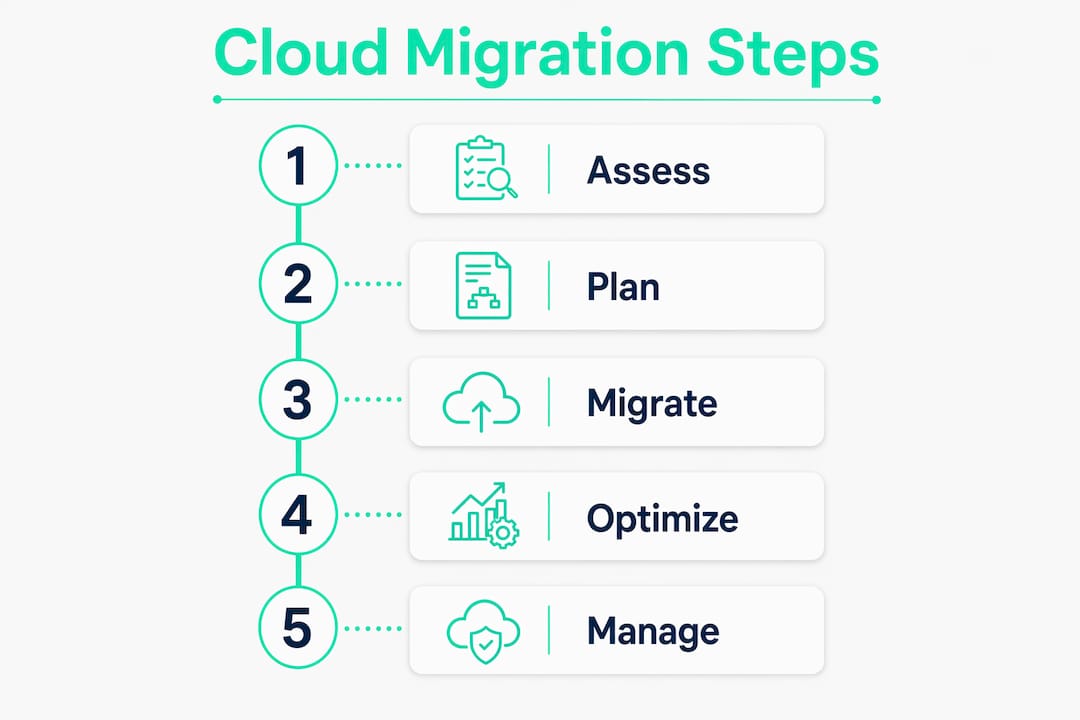
Stakeholder misalignment is one of the most common reasons migrations stall. CXOs often prioritize security and availability, while finance and operations leaders focus on cost savings. Portfolio rationalization gives both groups a common framework to evaluate trade-offs.
The migration approach for each application then follows from its classification:
- Re-host (lift and shift). Move the application to the cloud with no code changes. Fast and low-risk, but captures limited long-term value.
- Re-platform. Make targeted adjustments so the application uses cloud-native services like managed databases or container orchestration. Balances speed with modernization.
- Refactor. Rebuild the application to use cloud-native architecture. Delivers the most value but takes the most time and carries the highest risk.
- Retire. Decommission applications that no longer serve a business purpose.
Most enterprises refactor less than 10% of their application portfolio initially. Around 25–30% are re-platformed under speed and modernization balance constraints. The rest are re-hosted or retired. That distribution reflects a deliberate choice to move fast and modernize selectively, not a failure of ambition.
| Approach | Speed | Modernization value | Risk level |
|---|---|---|---|
| Re-host | High | Low | Low |
| Re-platform | Medium | Medium | Medium |
| Refactor | Low | High | High |
| Retire | High | N/A | Low |
Pro Tip: Set measurable outcomes before you start. Define cost reduction targets, uptime requirements, and developer productivity benchmarks. Without those baselines, you cannot demonstrate ROI to your finance team 12 months later.
What are common challenges of cloud migration and how can enterprises overcome them?
Cost overruns are the most predictable risk in enterprise cloud migration. Gartner projects that 80% of companies overspend by 20–50% on cloud migration costs when cost optimization is not embedded from day one. That is not a minor variance. It is the difference between a migration that wins executive support and one that gets canceled mid-program.
The main challenges enterprises face include:
- Application dependency complexity. Large enterprises often have hundreds of applications with undocumented dependencies. Moving one application without mapping its dependencies can break connected systems.
- Data movement at scale. Transferring terabytes or petabytes of data to the cloud requires careful planning around bandwidth, downtime windows, and data integrity validation.
- Organizational resistance. IT teams accustomed to managing physical infrastructure often resist cloud operating models. That resistance slows adoption and increases the risk of shadow IT.
- Scope creep in refactoring. Teams that attempt to refactor too many applications simultaneously create bottlenecks. Limiting refactoring scope prevents delays and keeps the program on schedule.
- Security and compliance gaps. Regulated industries like healthcare and financial services must map compliance requirements to cloud configurations before migration, not after.
Pro Tip: Run a dependency mapping exercise before you migrate any application. Tools like AWS Application Discovery Service or Azure Migrate can automate much of this work and surface hidden risks early.
How can enterprises measure the ROI and impact of cloud migration?
Cloud migration ROI combines direct cost savings with productivity gains and risk reduction. ROI models are most credible when presented as best, base, and worst-case scenarios rather than a single optimistic figure. Finance teams reject single-scenario models because they do not reflect real-world uncertainty.
The components of a complete ROI model include hardware and maintenance savings, reduced licensing costs, developer productivity gains, faster time to market, and reduced risk of outages or security incidents. Each component should be quantified separately and then aggregated.
Measuring migration success over 12–36 months captures both immediate cost savings and longer-term benefits like improved developer productivity and reduced technical debt. A 12-month view shows infrastructure savings. A 36-month view shows the compounding effect of faster delivery cycles and fewer legacy incidents.
| Time horizon | Primary benefit measured |
|---|---|
| 12 months | Infrastructure cost reduction, license savings |
| 24 months | Developer productivity, reduced incident costs |
| 36 months | Revenue impact from faster delivery, technical debt reduction |
Align on ROI expectations with your finance team before the migration begins. Surprises at the 12-month review damage credibility and make future investment approvals harder to secure.
What are best practices for executing a successful enterprise cloud migration?
Execution quality separates migrations that deliver on their business case from those that drag on for years. The following practices define what good looks like at enterprise scale.
- Build a comprehensive migration checklist. End-to-end migration planning covers pre-migration assessment, workload prioritization, security configuration, testing, cutover, and post-migration monitoring. DigitalOcean’s migration checklist framework is a widely used reference for structuring this work.
- Partner with cloud migration specialists. Internal IT teams rarely have deep expertise in all three major cloud platforms. External partners bring platform-specific knowledge and accelerate the program.
- Migrate in phases. Start with low-risk, low-dependency workloads. Prove the model, build team confidence, and refine your processes before tackling mission-critical systems.
- Monitor costs continuously post-migration. Cloud cost management is not a one-time exercise. Set up cost alerts, review usage monthly, and right-size resources as workloads stabilize.
- Invest in team training. Cloud operating models require different skills than on-premise management. Training your team on cloud-native tools and practices reduces errors and accelerates value delivery.
Enterprises that treat migration as a phased, iterative program consistently achieve better outcomes than those that attempt a single large cutover. The managed IT and cloud services model supports this approach by providing ongoing technical oversight after the initial migration is complete.
Key Takeaways
Successful cloud migration requires aligning business strategy, financial planning, and technical execution from the start, not as separate workstreams.
| Point | Details |
|---|---|
| Start with portfolio rationalization | Classify apps as “invest” or “sustain” before choosing a migration approach. |
| Embed cost governance early | Gartner data shows 80% of enterprises overspend by 20–50% without early cost controls. |
| Use scenario-based ROI models | Present best, base, and worst-case scenarios to win finance team approval. |
| Migrate in phases | Start with low-risk workloads to reduce disruption and build execution confidence. |
| Measure over 12–36 months | Short-term savings are real, but the full ROI picture takes three years to emerge. |
What I’ve learned from watching migrations succeed and fail
After working with enterprises across industries on cloud adoption, one pattern stands out above all others: the migrations that fail do not fail because of technology. They fail because the business case was built on a single optimistic number that finance never believed in the first place.
The most common mistake I see is treating refactoring as the default approach. Teams get excited about cloud-native architecture and commit to rebuilding too many applications at once. Six months in, the program is behind schedule, costs are climbing, and the CIO is fielding uncomfortable questions from the board. Limiting refactoring to the applications where it genuinely changes business outcomes is not a compromise. It is the right call.
The second pattern I see is treating cost optimization as a post-migration task. Cloud costs do not self-manage. Without active governance, teams provision resources for peak loads and never scale them back down. The cloud cost management discipline has to be built into the operating model from day one, not bolted on after the first quarterly bill arrives.
The enterprises that get this right share one trait: they brought in external expertise early, not as a last resort. Specialist knowledge shortens the learning curve and prevents the expensive mistakes that internal teams make when they encounter cloud-scale challenges for the first time.
— Ahmar
How Innovativelabs360 supports enterprise cloud migration
Enterprises that need both technical execution and long-term platform management find that a single, integrated partner delivers better outcomes than coordinating multiple vendors.
Innovativelabs360 brings a decade of hands-on experience managing cloud platforms that meet HIPAA and enterprise compliance standards. The team covers custom software development and cloud migration alongside round-the-clock IT support, so your systems are built and maintained for the long term. Whether you are planning your first migration or re-architecting an existing cloud environment, Innovativelabs360 provides the technical depth and operational continuity that enterprise programs require. Contact the team to discuss your migration goals and get a realistic assessment of your timeline and ROI potential.
FAQ
What does cloud migration mean for an enterprise?
Cloud migration is the process of moving an enterprise’s applications, data, and workloads from on-premise infrastructure to cloud platforms like AWS, Azure, or GCP. The goal is to reduce infrastructure costs, improve agility, and strengthen security.
What are the biggest challenges of cloud migration?
The most common challenges include cost overruns, application dependency complexity, organizational resistance, and compliance gaps. Gartner projects that 80% of companies overspend by 20–50% when cost governance is not built into the migration plan from the start.
How long does it take to see ROI from cloud migration?
ROI measurement should span 12–36 months. The 12-month mark captures infrastructure savings, while the 36-month view reflects developer productivity gains and reduced technical debt.
What is portfolio rationalization in cloud migration?
Portfolio rationalization classifies every application as either “invest” (modernize) or “sustain” (re-host or retire). This framework aligns business and IT stakeholders on migration priorities before technical work begins.
Which migration approach is best for large enterprises?
Most large enterprises use a mix of re-hosting, re-platforming, and selective refactoring. Refactoring fewer than 10% of applications initially prevents delays while still delivering meaningful modernization gains.